Product Video Reference:
https://youtube.com/shorts/qdhF5O3HHeM?si=Fj08WtHWbpYSN-y_
| Item |
Details |
| Blade Length |
70 cm (27.6 in, excluding habaki) |
| Handle Length |
16 cm (6.3 in) |
| Blade Width |
2.4 cm (0.94 in, tip) / 3.2 cm (1.26 in, base) |
| Blade Thickness |
4 mm (0.16 in, tip) / 7 mm (0.28 in, base) |
| Overall Length |
91 cm (35.8 in) without scabbard / 93 cm (36.6 in) with scabbard |
| Weight (Unsheathed) |
Approx. 1,180 g (2.60 lb / 41.6 oz) |
| Balance Point |
12 cm (4.7 in) from guard |
| Tang Width |
2.4 cm (0.94 in) |
| Steel |
Self-refined patterned wootz steel (Bin Iron) |
| Heat Treatment |
Traditional clay-applied differential hardening |
| Hardness |
Edge: ~HRC 58 / Spine & body: ~HRC 35 |
| Flexibility |
Bends approx. 20–30° |
| Blade Finish |
Hand-ground and hand-polished |
| Fittings |
Cast copper fittings |
| Handle Core |
Chicken-wing wood (Jichi wood) core with copper outer structure |
| Scabbard |
Ebony wood |
Product Overview & Craft Notes
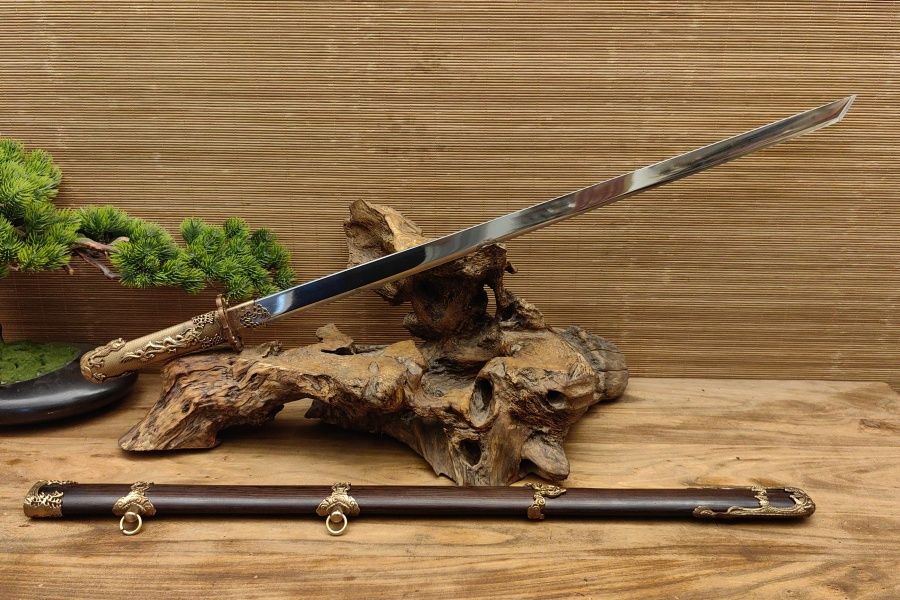
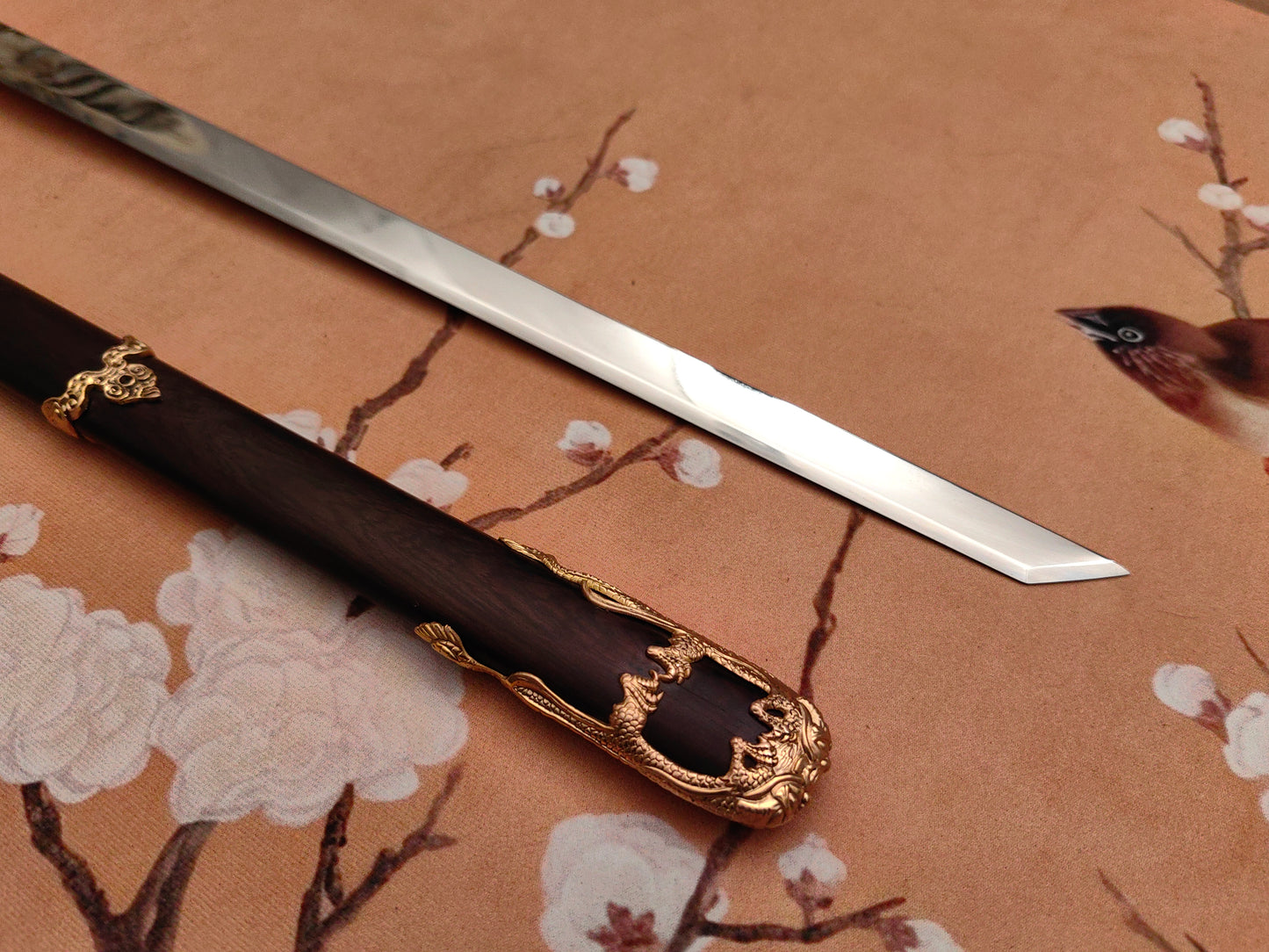
This Tang Dynasty–style dao, named “Water Dragon”, is crafted from self-refined patterned bin iron, a material historically prized for its distinctive flowing patterns and cutting performance.
The blade is treated with traditional clay-applied differential hardening, producing a hardened edge for cutting performance and a significantly softer spine for shock absorption.
This results in a blade with clear hardness contrast, balancing sharpness with structural resilience.
Compared to modern spring-steel sabers, this sword emphasizes material character and traditional heat treatment rather than extreme flexibility.
Its bending range is intentionally limited, reflecting the nature of differentially hardened blades, where edge retention and tactile feedback take priority.
🧠 Design Philosophy & Use
The Water Dragon name reflects the subtle, flowing surface patterns revealed through hand polishing—resembling water currents moving beneath the steel surface.
The use of ebony for the scabbard and chicken-wing wood for the internal handle core ensures both durability and dimensional stability, while the cast copper fittings provide a solid, historically grounded finish.
This blade is best suited for:
Collection and appreciation of traditional metallurgy
Historical study and handling
Display alongside other high-end Chinese blades